


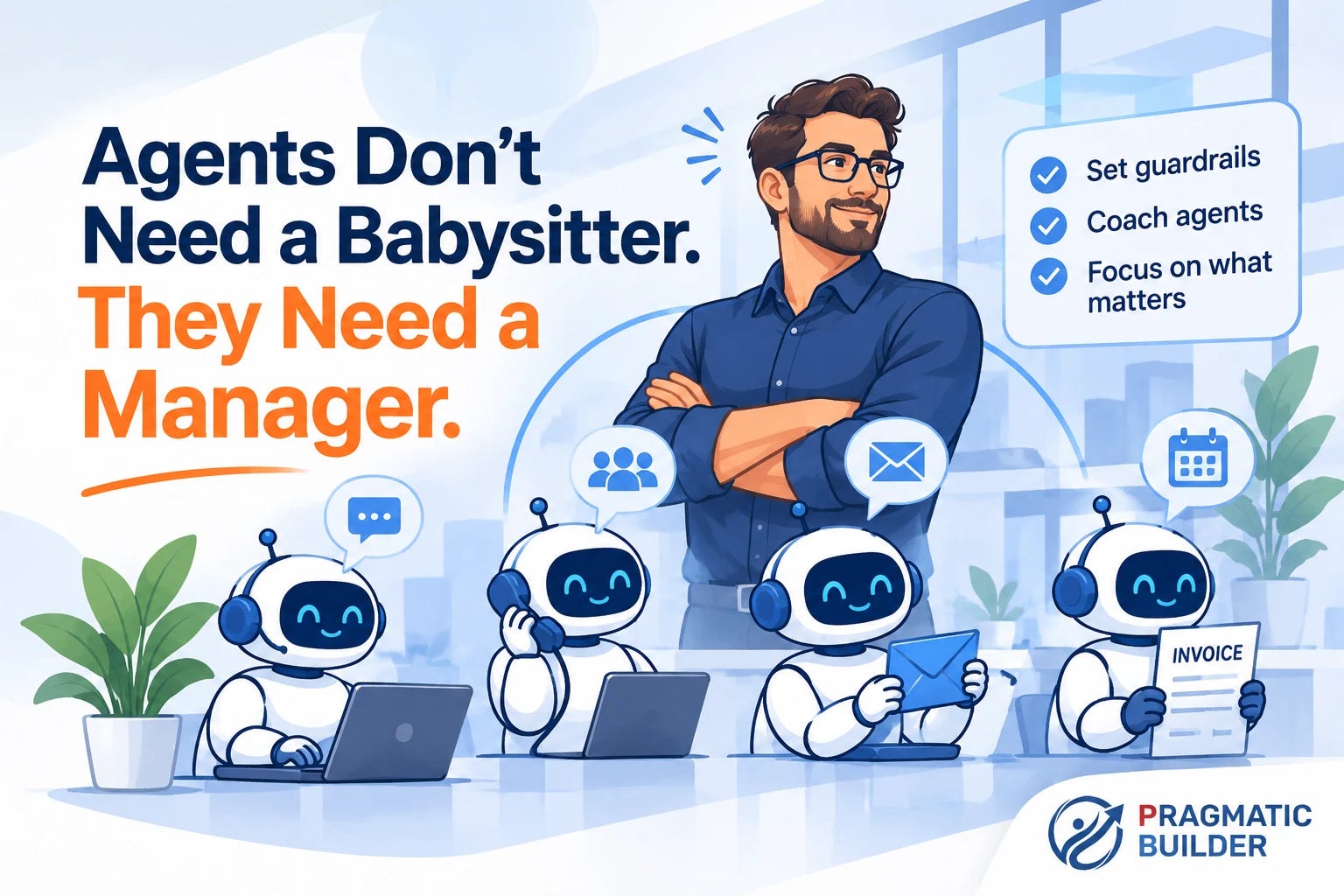
Most writing about AI at work ends in the same safe place: the agent drafts, a human approves everything.
I understand why. It sounds responsible. But I’ve come to think it’s a waypoint, not the destination. And if you stay there too long, it quietly fails on its own terms.
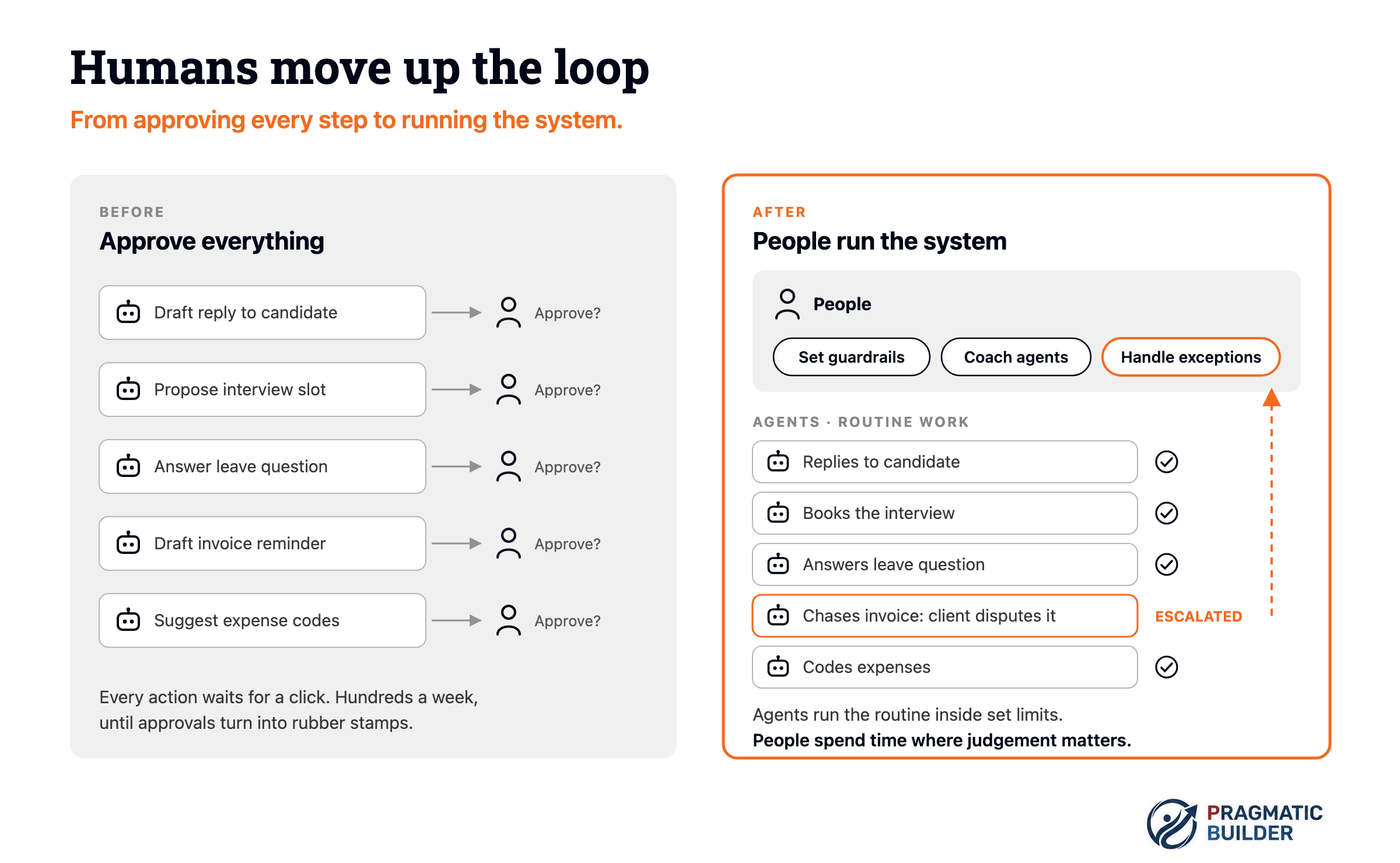
Picture an ops manager at a 40-person company who has to approve every agent action. On Monday they read each draft carefully. By Thursday they’re on approval number 180 of the week, and they’re clicking “approve” the way we all click “accept cookies”. You’ve kept the cost of a human in the loop and lost most of the benefit.
What I’m building
For the past months I’ve been building an operating system for small and mid-size companies. Today we focus on three functions: HR, recruiting and finance. Others are already in the pipeline.
The goal isn’t an assistant that waits for someone to click. It’s agents that do the common work on their own:
A candidate asks at 22:00 whether the role is hybrid. An agent answers, with the right details, in a minute.
An employee asks how many vacation days they have left. An agent answers from the actual records.
An invoice is ten days overdue. An agent sends the reminder, follows up, and only pulls in a human when the client disputes it.
A hiring manager frees up Thursday afternoon. An agent rebooks three interviews around it.
None of that needs a human click. All of it needs a human who decided how it should work.
The ROI nobody’s selling
Here’s the part I care about most. The ROI isn’t “do it with less people”. It’s “let the people who are left do the part only they can do.”
In a small company, everyone is doing three jobs. The recruiter is also the person reconciling spreadsheets. The finance lead is also chasing approvals in email. What those people tell me they want isn’t fewer colleagues. It’s less clicking around in software, and more time talking to the humans who matter: candidates, clients, the team.
That isn’t just my impression. A Stanford team surveyed 1,500 workers across 104 occupations about which tasks they’d like AI agents to take over. For 46% of tasks, workers were positive about automation, mostly repetitive, low-value work, and the main reason was freeing up time for higher-value work. They also found that the skills that most need a human are increasingly interpersonal and organisational: planning, coordinating, teaching others.
The productivity side is starting to show up in controlled studies too. In a field experiment by Harang Ju and Sinan Aral, 2,234 people were randomly paired with either a human or an AI agent to produce ads. The human-AI teams produced about 50% more per worker, and people delegated more to the agent than to a human partner.
And here’s the caution. McKinsey’s 2025 State of AI survey found AI in regular use at 88% of organisations, yet fewer than four in ten report any impact on earnings at company level. My read: bolting an agent onto an old process gets you a nice demo. Redesigning the work around agents gets you results. Small companies have an advantage here, because a 40-person company can redesign a process in a week.
Agents as virtual employees
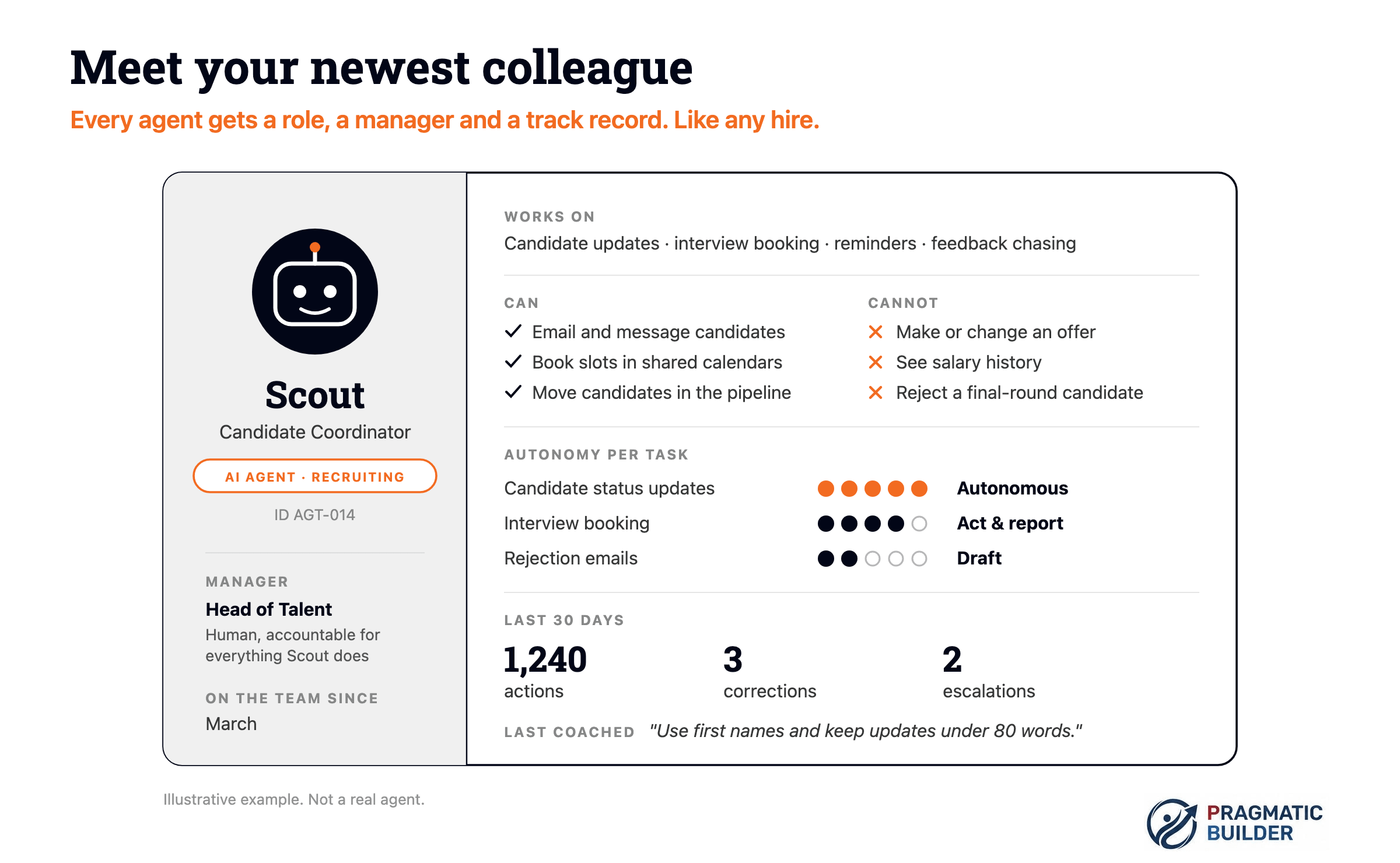
The most useful mental model I’ve found is to treat every agent like a new hire.
It has a name and a role. It has a manager, a real person who is accountable for what it does. It has a clear list of what it can and cannot do. And it builds a track record that everyone can see.
The big platforms are converging on the same idea from the enterprise side. Microsoft’s Entra Agent ID gives each agent its own identity with a lifecycle, and is designed so there’s always a human sponsor accountable for it, even when people change roles. Workday announced an “Agent System of Record” in 2025 to register and manage agents alongside human workers. That’s still mostly vendor announcement rather than proven practice, but the direction is telling: agents are getting org-chart positions.
Autonomy is earned per task, not granted per agent
This is the core of how I think about safety. It’s not “trust the agent” or “don’t trust the agent”. It’s a ladder, and each task climbs it separately.
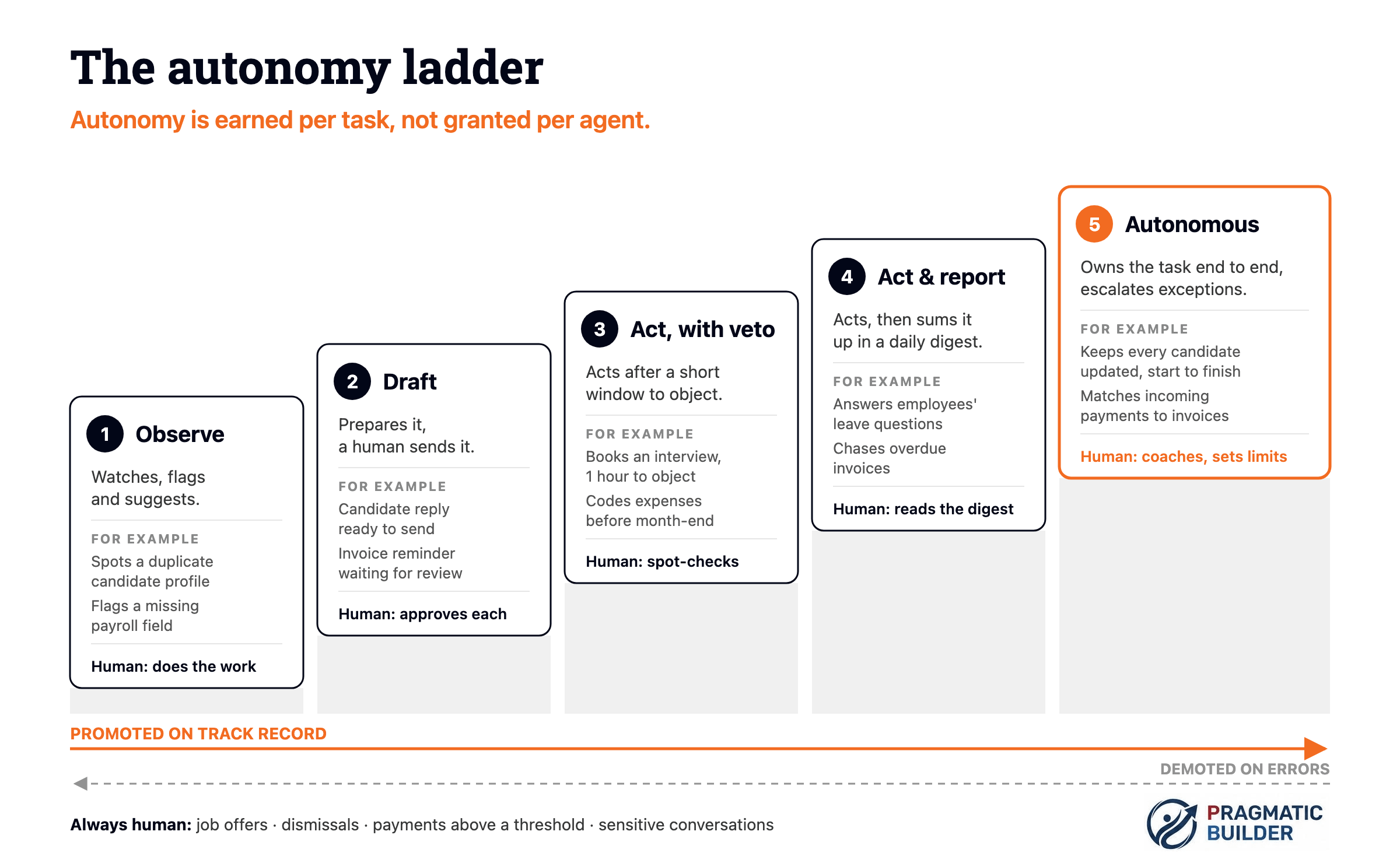
The same agent can be fully autonomous at sending candidate status updates, at “act and report” for booking interviews, and still at “draft” for rejection emails. It moves up a rung when its track record earns it, and it moves back down when it makes mistakes.
A few rules make this work in practice:
Risk and reversibility set the starting rung. A wrong interview time is annoying and fixable. A wrong payment isn’t. Start each task where a mistake is cheap.
When unsure, escalate. Never guess quietly. The expensive failures aren’t agents being wrong. They’re agents being wrong and confident. An agent that says “this doesn’t fit any pattern I know, over to you” is doing its job.
Log everything. Every action, against the agent, the task, and the human accountable for it. That’s how you promote with confidence, and how you debug when something goes sideways.
Some things stay human. Job offers, dismissals, payments above a threshold, sensitive conversations. Not because agents can’t draft them, but because a person should own them.
On the engineering side, orchestration frameworks are making this easier to build. LangGraph can pause a workflow at a checkpoint, wait for a human, and resume. Microsoft’s AutoGen treats the human as a participant in a conversation between agents. Tools like HumanLayer let agents ask a person for input or approval mid-task. The pieces exist. The design choices are yours.
Agents that learn on the job
The difference between a tool and a colleague is that a colleague gets better.
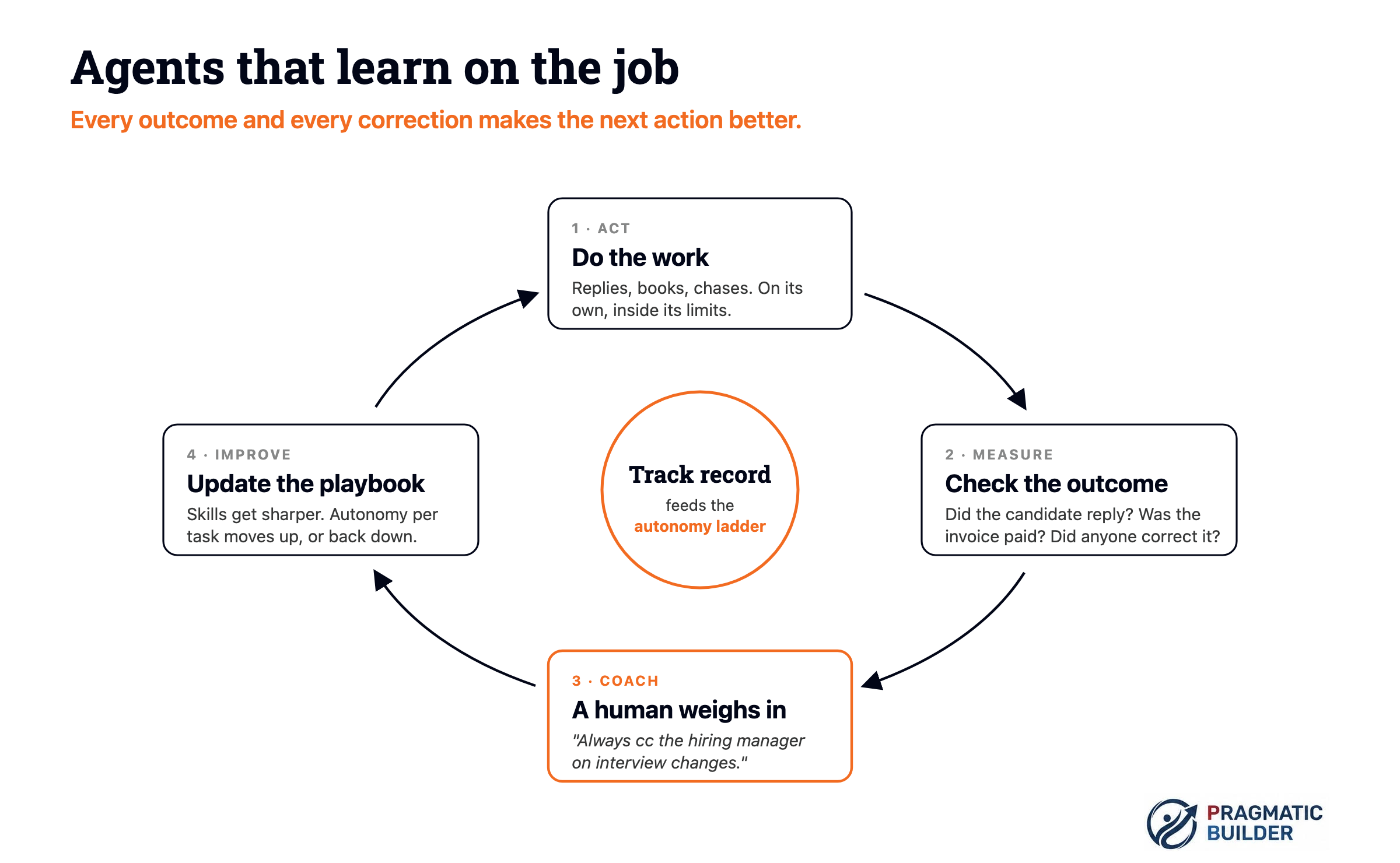
Every action has an outcome. Did the candidate reply? Was the invoice paid? Did someone correct the agent’s message? Those signals, plus direct guidance from the people running the system (”always cc the hiring manager on interview changes”), feed back into how the agent works. Its playbook improves, and its autonomy on each task moves up or down based on evidence, not on how impressive the demo was.
This changes the human’s job. The operator stops being a gatekeeper approving every email and becomes a coach: setting the guardrails, teaching the agents, and stepping in on the exceptions that need judgment.
Flexibility a small team never had
There’s one more benefit I didn’t expect to matter as much as it does. Small companies live in peaks: a hiring surge after a big client win, month-end close, onboarding six people in one week. Before, you’d absorb that with overtime or a rushed hire. Agents stretch to the peak and shrink back after it. For a team of five, that flexibility is worth as much as the hours saved.
The honest open questions
I’m optimistic, but I don’t think this is all solved.
The Stanford workers survey also found that people generally want more human control than the technology now requires, and that an equal partnership is what most want. That’s a real tension with the direction I’m describing, and it means bringing people along matters as much as the tech.
There’s also the entry-level question. Stanford’s “Canaries in the Coal Mine” study, using payroll data, links generative AI to falling employment for early-career workers in the most exposed jobs. If agents do the junior work, how do juniors learn the job? I don’t have a full answer yet. Part of mine is making “coaching agents” a skill juniors learn early, because it forces you to understand the work well enough to teach it.
Where this goes
In two or three years, I think every small company will have a mixed team: a handful of people and a larger group of agents, each with a role, a manager and a track record. The companies that win won’t be the ones with the most agents. They’ll be the ones whose people spend their time on the work only people can do.
I’d love to hear where you are on this. Which tasks have you handed to an agent end to end? What made you trust it, or what stopped you? And where should a human always stay in the loop?
Further reading
Shao, Zope, Jiang, Pei, Nguyen, Brynjolfsson, Yang. Future of Work with AI Agents: Auditing Automation and Augmentation Potential across the U.S. Workforce. Stanford, 2025.
Ju, Aral. Collaborating with AI Agents: Field Experiments on Teamwork, Productivity, and Performance. Johns Hopkins / MIT Sloan, 2025.
Brynjolfsson, Chandar, Chen. Canaries in the Coal Mine? Six Facts about the Recent Employment Effects of Artificial Intelligence. Stanford Digital Economy Lab, 2025.
McKinsey. The State of AI in 2025: Agents, innovation, and transformation.
Microsoft. What is Microsoft Entra Agent ID?
Workday. Workday Unveils New Agent System of Record. Press release, February 2025.
LinkedIn discussion on this topic
I shared a short version of this on LinkedIn. The conversation is happening there, so join in:
Agents don’t need a babysitter. They need a manager.
Most “AI at work” posts end in the same safe place: the agent drafts, a human approves everything. I think that’s a waypoint, not the destination.
I’m building an operating system for small and mid-size companies. Today it runs HR, recruiting and finance. More functions are already in the pipeline. The goal isn’t an assistant that waits for someone to click “approve”. It’s agents that do the common work on their own: they talk to candidates, answer employees, chase the invoice, book the interview. And they get better every week, from feedback and from what the human operators teach them.
That’s the part nobody’s selling: the ROI isn’t “do it with less people,” it’s “let the people who are left do the part only they can do.”
Humans don’t leave the loop. They move up it. They set the guardrails, coach the agents, and step in where it really matters, instead of signing off on the 200th routine email of the week.
So I’m curious where you are on this:
Which tasks have you handed to an agent end to end?
What made you trust it, or what stopped you?
Where should a human always stay in the loop?
#AIagents #FutureOfWork #SME #Automation
Join the conversation on LinkedIn: https://www.linkedin.com/feed/update/urn:li:activity:7530583369470963713/