


The software industry is obsessed with top-line numbers right now. We hear things like “3/4 of all code at Google is now written by AI,” and everyone immediately jumps to a flawed conclusion: Software engineering is becoming a pure game of prompting.
That is a dangerous illusion. If you treat AI like a magical slot machine where you just “vibe-code” your way to production, you aren’t accelerating your throughput—you are just compounding your cognitive debt at an unprecedented velocity.
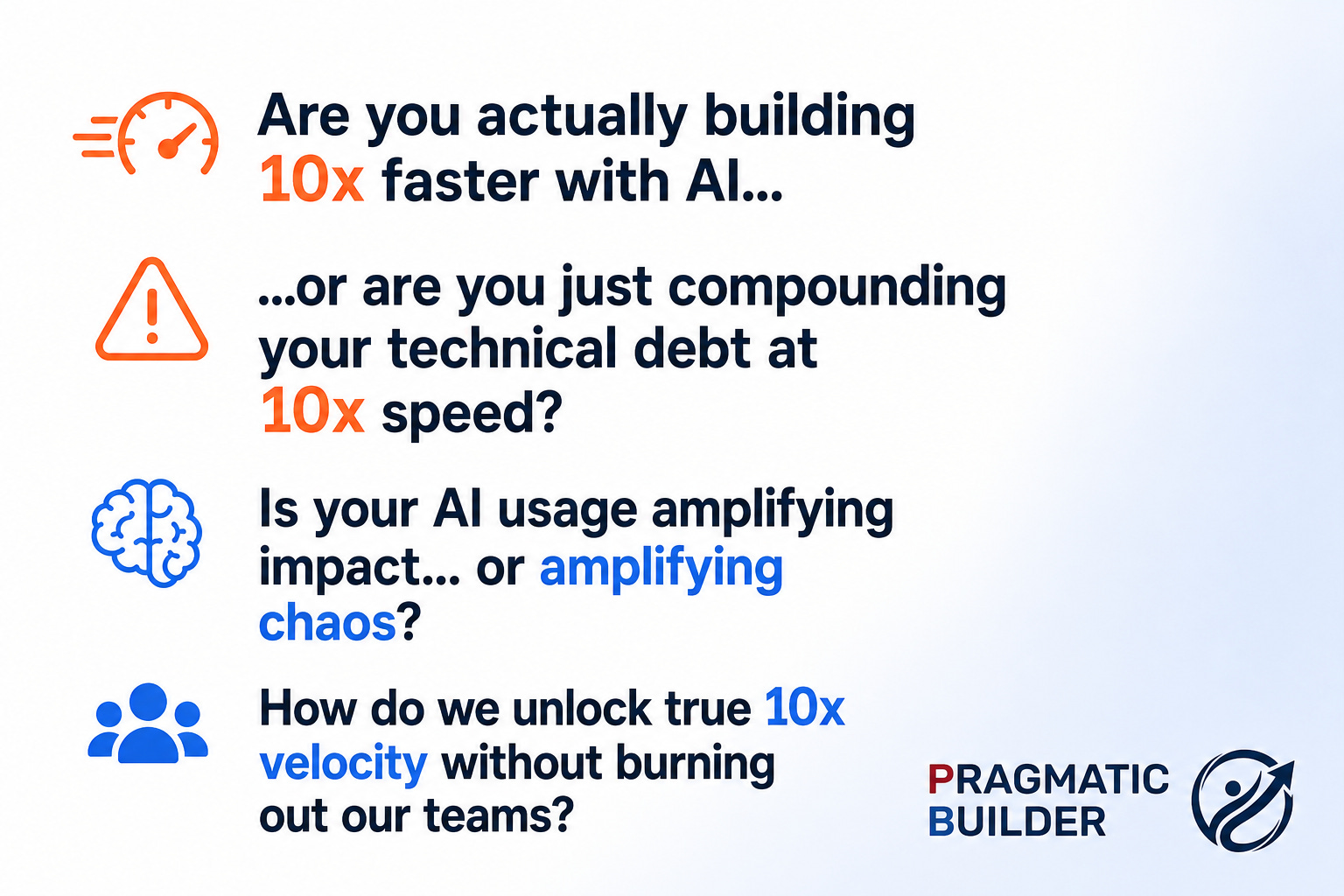
As a pragmatic builder, my focus has always been on systems that actually work, scale, and survive in production. And after digesting recent internal data out of Google’s Developer Intelligence team, a fundamental truth has been validated: AI doesn’t erase the need for deep engineering; it aggressively penalizes the lack of it.
To survive and thrive as builders in this AI-native era, we have to evolve our roles. We aren’t code-monkeys, nor have we ever been that. We are builders, system architects, orchestrators, and value translators. We need to become T-Shaped Builders 2.0.
The Paradox of Vibe Coding
Google’s Dora team discovered a massive “productivity paradox.” While individual developers feel faster using AI extensions, team-level delivery can actually slow down. Why? Because writing unverified, context-deaf code into a shared repository creates massive evaluation bottlenecks and integration chaos.
AI is both a mirror and an amplifier. If your engineering practices, system designs, and team cultures are structured, AI magnifies your strength. If your infrastructure is fragile, data is siloed, and processes are broken, AI will just help you build catastrophic technical debt 10 times faster.
So how do we fix it? We focus on the system, not just the code.
       The AI-Native T-Shaped Developer Framework
  ┌──────────────────────────────────────────────────┐
  │         AI ENGAGEMENT & ORCHESTRATION            │ ◄── (New Core Horizontal Layer)
  ├────────────────────────┬─────────────────────────┤
  │ ADJACENT ENGINEERING   │ ADJACENT NON-ENGINEERING│ ◄── (Extended Wings: Context)
  │ (Infra, Sec, Ops)      │ (Business, Product, UX) │
  └───────────┬────────────┴─────────────────────────┘
              │  DEEP DOMAIN & CORE ENGINEERING      │ ◄── (The Stem: Precision & Verification)
              └──────────────────────────────────────┘
1. The Core Stem: Precision Engineering Over Intellectual Passivity
The horizontal bar of a traditional T-shaped engineer is expanding, but the stem—the deep, specialized engineering knowledge—has never been more critical.
When code is generated instantly, verification becomes your ultimate bottleneck. If you accept machine output wholesales because it “sounds confident,” you are practicing intellectual passivity. Pragmatic builders delegate tasks, never judgment.
How to stay sharp:
Reimplementation loops: Don’t just accept the first draft. Force the AI to tear it down and rebuild it differently. Ask it to explain why it made alternate trade-offs.
Trace walkthroughs: Spend time walking through agent decision traces or “alien code” (code you didn’t write) to keep your mental model of the system intact.
2. Shifting Left on Intent (Spec-Driven Development)
Traditionally, “shifting left” meant moving security or testing to an earlier stage in the pipeline. Today, shifting left means capturing structured intent.
The fundamental source of truth is moving away from the code itself and toward upfront specification files. If you let an agent workforce build without rigid specifications, you build a prototype nobody understands.
The Spec is the Deliverable: Spend your cognitive energy upfront debating constraints, business logic, and user requirements. Treat your
.specor skill files like real code—versioned, observed, and fiercely protected.
3. Moving from Conductor to System Orchestrator
The era of chatting with a single AI companion is over. The future belongs to asynchronous multi-agent architectures.
Instead of asking one LLM to write a complex migration, modern teams build systems of reasoning. For instance, Google tackled delicate TensorFlow migrations by deploying a strict three-agent architecture:
A Planner Agent to map verifiable steps.
An Orchestrator Agent to group and route execution.
A Coder Agent to execute the changes within defined style guides.
As the human engineer, you sit above this loop. You build the environment, set the guardrails, and track agent performance traces.
4. Becoming a Value Translator
Since AI handles the routine execution of how to code, the pragmatic builder’s real value shifts up the abstraction stack to the what and the why.
When a product request asks to “improve database performance,” a weak prompt results in a generic refactor loop. A Value Translator looks at metrics, asks “Performance for which user segment under what context?” and guides the agent network to optimize the critical paths that move the business needle.
The Leadership Mandate: Protect the Struggle
If you are managing or leading teams, remember W. Edwards Deming’s classic phrase: “A bad system will beat a good person every time.” You cannot demand a 10x output if it means crushing your developers under 10x cognitive load and constant agent context-switching. To prevent burnout, leaders must make three immediate shifts:
Stop measuring lines of code or PR volume. (hope you never did that) Reward outcomes and met business requirements.
Protect the “productive struggle.” Carve out dedicated time for devs to whiteboard systems, audit infrastructure, and experiment with tooling.
Build absolute psychological safety. Agentic systems will fail. If your culture punishes failure, engineers will retreat to old, slow, safe ways of working.
Stepping Up, Not Stepping Aside
The craft of software engineering isn’t vanishing; it’s stepping up to its highest and most powerful altitude. We are moving from hand-crafting bricks to precision-engineering the ecosystem that safely allows buildings to exist.
Let’s stop vibe coding. Let’s start system designing.
What does your agent-orchestration stack look like today?
Do you have something worth sharing that works nicely for your team?
Drop your thoughts in the comments.